

SPECIAL REPORT: Optics of the Future: Realism & Fantasy
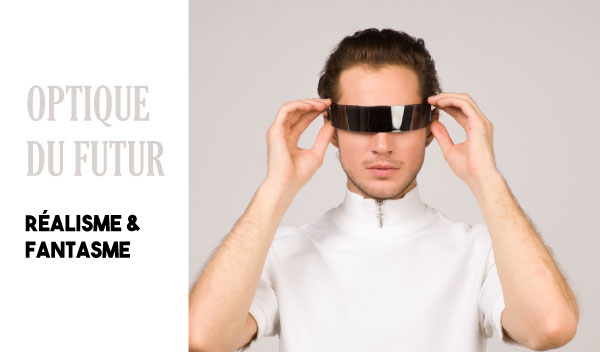
It's been almost ten years since connected optical devices became a concrete concept. Like any technological innovation, they experienced a period of initial stumble before taking off. Their arrival is only a matter of time. While expectations are still high for major American tech brands, particularly the GAFA companies, who were the first to communicate without yet having convinced everyone, some models are already making their mark on the market. This new report on the optics of the future will provide an overview.
Optics of the future: the digital revolution, at last?
Since the launch of Google Glass in 2011, smart glasses have become a more concrete project, but one that seemed infinitely more difficult to implement than a smartphone or a watch. This was due to the device itself, which offers little space for integrating a digital system. The promising project was at a standstill three years later. The idea seemed good, but unfeasible. The device's aesthetics and practicality were bound to be lacking. Furthermore, inserting a camera into an optical device raised privacy concerns. Digital technology seemed to have reached its limits, and the revolution would stop there. But this was without taking into account technological progress and the determination of researchers who gradually managed to overcome the obstacles and difficulties. The most surprising thing was that, for once, the revolution wasn't going to come from the tech giants. The main problem stems primarily from comfort, because in terms of features and possibilities, there is no shortage of ideas. Video games have already begun their technical and technological transformation with virtual reality , allowing for total immersion in the game. 
The mixed reality, already at the point
But for glasses, it looks infinitely more complicated. That doesn't mean abandoning the idea, however. Above all, before commercialization to the general public, there's an opportunity to help the professional sector. Artificial intelligence allows companies like DHL, Boeing, and General Electric to be offered devices to facilitate their work. This is also the case in the medical field. After all, if the aesthetics aren't suitable, that's not a problem; the main objective is to save time and increase productivity. The user, on a construction site or during an operation, will be able to benefit from mixed reality , a blend of the real and virtual worlds. Other tech players, whether members of the GAFA (Google, Apple, Facebook, Amazon) or not, continue to believe in it. Facebook and Apple, in particular, specify that they are still working to improve their prototype. Especially since some studies predict the obsolescence of the smartphone within the next decade. Glasses and watches would therefore no longer simply complement the phone, but replace it altogether.
The optics of the future in the context of the Internet of Things
But what will glasses of the future look like? In the early 2000s, it was difficult to imagine what, twenty years later, we would be able to do with a phone… Will it be the same with our glasses? Probably. We might even be more dazzled. Indeed, glasses of the future could and should incorporate a form of artificial intelligence far more advanced than what we know. So, yes, the launch of smart glasses seems very slow, but we must also consider our awareness of the possibilities, which is far greater than in the last century.
According to EyeSee Mag : " Not only will AI be able to reproduce precise behavior, but it will also be able to predict, judge, and learn from what the user sees, reads, writes, and listens to, and then adapt or anticipate. Combined with ever-increasing amounts of data, even more powerful artificial intelligence technologies, and increasingly advanced algorithms, the assistants that will equip our glasses of tomorrow will undoubtedly know their owner's habits intimately and will be able to identify and anticipate their needs on demand, quickly becoming indispensable. "
Above all, the glasses will automatically need to be integrated into a connected environment , known as the "Internet of Things" (IoT), an infrastructure that connects all objects connected (from the fridge to the TV to the cat's food bowl?)
Optical devices without limits?
But let's stick with the glasses. In practical terms, what would that look like?
What is now certain is that the smart glasses of the future will integrate at least the features of our phones (navigation, call and message management, media, etc.), sometimes making them more practical thanks to the device (sports, translation, driving, etc.).
The Chinese brand Xiaomi has already presented an ambitious device, without yet announcing a name, price, or release date.
But in the future, could it be even more incredible?
Indeed, we can already consider possibilities that surpass the imagination. So why couldn't these glasses, which can display your shopping list or prevent you from getting lost in the woods, also allow you to see perfectly in the dark, increase your field of vision, or restore perfect sight to the visually impaired? Devices are already working towards this goal, and even the wildest dreams could become reality. Other functions could be incredibly useful: the ability to capture everything, isolate parts of an image, make your optical frames adapt to changing light conditions in seconds to become sunglasses, or even perform this change yourself. Today, ideas are plentiful, but rather the challenge lies in knowing how to adapt them. And while we're only talking about glasses here, we mustn't forget contact lenses, which are constantly evolving towards cutting-edge technology. Connected contact lenses are also the future of optics and hold great promise. 
The future perspective is determined
It is now a concrete fact that smart glasses are and will be the optics of the future . While the first models haven't yet achieved the meteoric success of phones or watches, they are poised to change our perception. They are also preparing the ground and the market for major players. These players will not allow products that are not fully functional to be sold. The train has been jumped on, and one might think it's running late, but that was without taking into account the unpredictable nature of eyeglasses, which require further technical and technological feats and a level of Research and Development even higher than what is currently being done. But there is no doubt that in the coming decade, these devices will be indispensable, firstly because they are beginning to prove themselves, and secondly because their trajectory is, all things considered, meteoric. Our perception tends to want to speed things up, without taking into account the immensity of the task. To find out, we'll have to wait and see. Sources: eye-see-mag.com , www.lesnumeriques.com