

Eyewear Made in Europe: the industry is returning to its roots

For decades, the eyewear industry followed the relentless logic of globalization: offshoring to reduce costs and benefit from overseas expertise. Today, something is changing. Between geopolitical turmoil, consumer pressure for traceability, and the new customs realities imposed by the Trump administration, producing in Europe is once again becoming not only a value, but a strategy. A genuine industrial shift or a carefully packaged marketing ploy? The answers are more nuanced than one might think.
European-made eyewear: Italy remains strong
It is from Veneto—and more precisely from the Longarone basin in the Belluno region—that the heart of the global eyewear industry still beats. Italy manufactures, assembles, and innovates. It also exports massively: nearly 90% of its production goes abroad, totaling €2.8 billion in the first half of 2025. But this dependence on exports makes it vulnerable . In the first half of 2025, Italian exports to the United States plummeted by 34.5% following the imposition of new American tariffs. Conversely, Europe saw an 8% increase, led by Germany, Spain, and Eastern Europe, which now account for nearly 60% of the market. Faced with this situation, Lorraine Berton, president of ANFAO (the Italian National Association of Eyewear Manufacturers), is calling on institutions to actively support the excellence of " Made in Italy ." This label is now seen as both a safeguard and a selling point. It was with this same logic in mind that LVMH anticipated this trend by inaugurating Manifattura Thélios in Longarone in 2018—a factory dedicated to the production of eyewear for the group's brands (Dior, Givenchy, Bulgari, etc.), entirely based in Italy. This represents both a symbolic and industrial investment in the country. 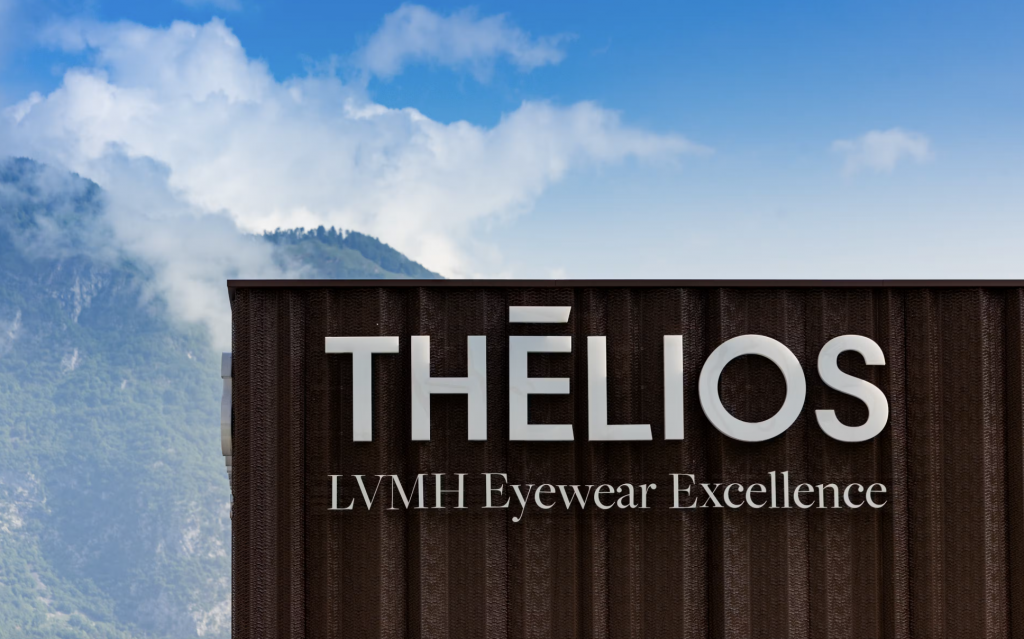 Thelios Manufacture by LVMH – LVMH credits[/caption]
In France, the Jura region is resisting, and Krys is investing!
In France, the Jura region remains the cornerstone of national manufacturing. The Jura department is home to nearly 50 companies in the eyewear sector , employing approximately 1,600 people directly and accounting for 60% of national production. Pioneering players like Vuillet Vega , whose production has remained in Morez since the 19th century, embody a rare industrial continuity on a global scale. In the spirit of "Made in France," the most documented relocation in recent years is that of Krys Group . In May 2024, the group inaugurated the expansion of its industrial site in Bazainville (Yvelines), the culmination of a €16 million investment over three years, including €800,000 in public subsidies. The result: increased production capacity from 1.4 to 1.8 million lenses per year—a rise of over 30%. As the first lens manufacturer certified "Origine France Garantie" (Guaranteed French Origin) since 2012, Krys is therefore the only optical group to manufacture its own lenses in France.
CSR and traceability: the new requirements that are accelerating the movement
Relocation is no longer just an economic decision. It's also a response to new regulatory and societal expectations. The European Corporate Sustainability Reporting Directive (CSRD), which has been phased in since 2024, requires large companies to precisely document their carbon footprint, including their supply chain. Producing in Europe shortens this chain, reduces intercontinental maritime transport—and therefore, automatically improves CSR indicators.
It is also a response to the growing demand for traceability from consumers and prescribing opticians. Knowing where, how, and by whom a frame was manufactured has become a selling point in its own right — particularly in the premium segment and in mutual cooperative networks.
The real limitations of eyewear Made in Europe
However, it would be an exaggeration to speak of massive reindustrialization. The sovereignty barometer published in January 2025 reveals that 9 out of 10 business leaders rule out any relocation to France. The cost structure of the eyewear industry remains restrictive: in the manufacture of glasses, labor represents two-thirds of the cost price of a frame—an economic reality that neither labels nor subsidies can eliminate.
In this context, some brands are doing their best: glasses assembled in Europe, designed in Europe, designed in France … even if these formulations do not guarantee that the components — nose pads, hinges, screws, acetate — are of European origin, the reality on the ground coexists with consumer expectations and the values of each player in the industry.
European-made eyewear: a sustainable trend or a marketing ploy?
Well… probably both! The geopolitical pressure is real: US tariffs on European imports, set at 15% under the EU-US agreement of July 2025 , have profoundly restructured export flows, pushing companies to consolidate their domestic markets and leverage their local roots. Those companies that are truly investing—Krys, LVMH/Thélios, the eyewear manufacturers of the Jura region—are not doing so because it's trendy, but because industrial sovereignty has once again become a strategic priority.
For opticians, this return of Made in Europe is a concrete opportunity: to value the origin, tell a story of manufacturing, differentiate the offer on a qualitative and ethical criterion, and it is precisely here that human advice will make all the difference…
Featured Photo Credit: Photo by Dušan Cvetanović