

Audio and Optical Swimming Equipment: all connected equipment!
In terms of data, swimming has long been the most "data-deprived" sport. A watch left in the locker room, an app on the phone at the poolside, and the impossibility of looking up without breaking your rhythm. In 2026, this is thankfully a thing of the past! Heads-up display goggles, bone conduction headphones, onboard AI, and integrated corrective lenses : the augmented swimmer has arrived.
An overview of the equipment that truly changes the game and can be recommended for competitive swimmers, weekend triathletes, or simply anyone who wears corrective lenses and is looking for a solution for the pool…
Swimming, the number one sport in France and a blank canvas for innovation
With over 15 million regular participants in France , swimming is the country's most popular sport. Yet, until very recently, it remained the poor relation of wearable innovation: while cyclists can consult their bike computers and runners their GPS, swimmers had only the muffled sound of the water around them as feedback. Now, this technological gap has been filled by a generation of equipment that rivals land-based devices.
Smart glasses: view your data without leaving the water
This is the most significant innovation in the swimming world over the past two years. Three major players will compete in this market by 2026 , each with distinct approaches.
Form Smart Swim 2 — The proven benchmark
Launched in 2024 and continuously improved since, the Form Smart Swim 2 has established itself as the global benchmark for connected swimming goggles. Its key feature: an augmented reality heads-up display (HUD) integrated into the lens, visible without interrupting swimming.
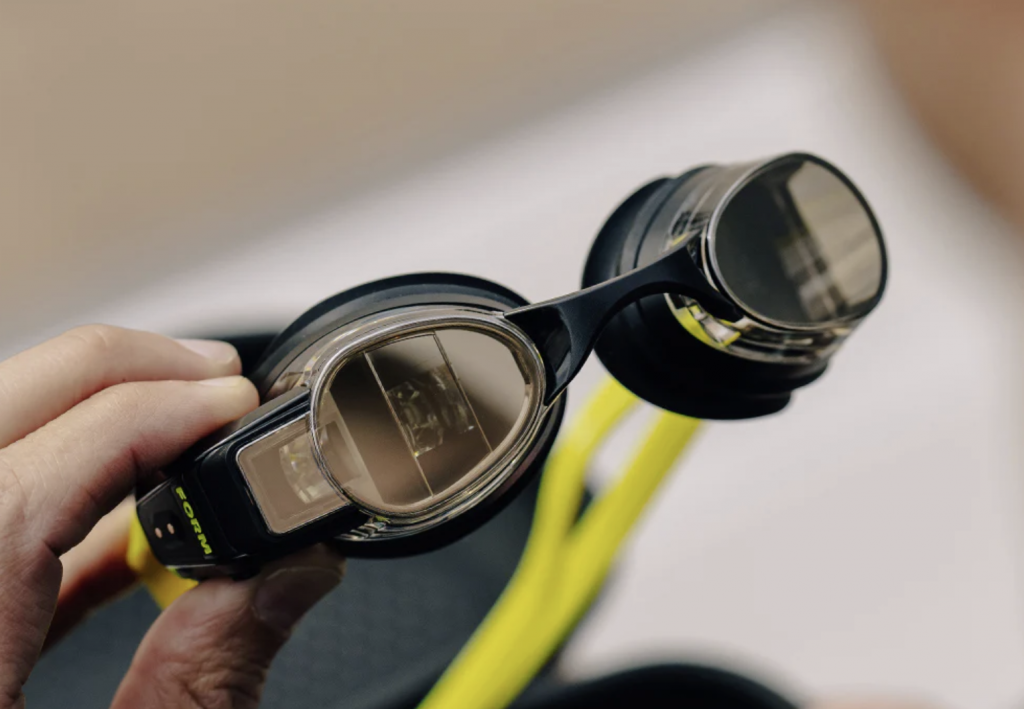
The swimmer can view their time, distance, pace, stroke rate, calories burned, and even heart rate in real time. Swimming style detection and lap counting are automatic—no buttons to press.
The Smart Swim 2 PRO version, launched in 2026, takes things a step further: it features Corning® Gorilla® Glass 3 lenses—a first in swimming goggle design—for significantly greater scratch and impact resistance than plastic models. The display remains visible for wearers with prescription lenses up to -3 diopters.
For those on a tighter budget, Form launched the Smart Swim 2 LT in June 2026 — a lighter version that retains the essentials: the HUD, swim tracking, and guided coaching via HeadCoach. It lacks the integrated heart rate sensor, and the price is lower too.
Holoswim 2 Pro: CES 2026 innovation
Holoswim surprised everyone at CES 2026 in Las Vegas by presenting its Holoswim 2 Pro — glasses that display data in a holographic OLED micro-screen integrated into the right temple, in fluorescent green to remain readable even in dimly lit chlorinated water.
What distinguishes the Holoswim 2 Pro : an obsession with comfort with 77g on the scale , nine different nose bridges (four classic, five curved), a reinforced headband for intense effort — and the possibility of integrating corrective lenses up to -7 diopters .
Their Smart AI records movements, analyzes performance and offers personalized suggestions with a claimed accuracy of 97% — superior to smartwatches on swimming-specific measurements!
Vuzix Labs Smart Swim — The B2B pioneer
Less mainstream but a pioneer in the sector, Vuzix Labs Smart Swim paved the way as early as 2020 with an augmented reality device that could be attached to any pair of swimming goggles.
Priced at $500, it allows for real-time performance tracking as well as easier communication with the coach — a particularly appreciated feature in high-level swimming clubs.

Swimmers wearing corrective lenses: a target finally being addressed
Yes indeed, this is the angle that opticians must no longer overlook!
Traditionally, corrective lens wearers had two unsatisfactory options: swimming without anything (and seeing nothing) or wearing contact lenses in the pool (formally discouraged for health reasons).
Fortunately, the new generation of smart glasses finally addresses this problem.
Of the models mentioned above, the Holoswim 2 Pro accepts corrective lenses up to -7 diopters . The Form Smart Swim 2 displays its HUD clearly for wearers with prescriptions up to -3 diopters .
And regardless of the connected aspect, all the major brands of swimming goggles now offer models with integrated corrective lenses ( Speedo , Arena, Zoggs, SWANS) or adaptation kits.
For an optician, this is advice that can change the daily life of a swimming patient, and build loyalty among customers who did not expect them to be in this area.
Sound underwater: bone conduction revolutionizes swimming audio
The other major revolution, less visible but just as real: audio. The problem with water is that it blocks electromagnetic waves—so Bluetooth is unusable underwater. Two solutions have emerged.
Shokz OpenSwim & OpenSwim Pro: the essential references
Shokz has established itself as the world leader in aquatic audio thanks to its bone conduction technology: sound is transmitted via vibrations through the cheekbones and jawbones, bypassing the eardrum. As a result, the ears remain free, earplugs become optional, and the risk of swimmer's ear—a common condition—is significantly reduced.
The OpenSwim (30g, titanium, IP68, 4GB storage, 8-hour battery life) operates in standalone MP3 mode — the audio file is loaded onto the headphones before the session, as Bluetooth is unusable underwater. Compatible with swim caps and goggles.
The OpenSwim Pro adds dual functionality: standalone MP3 playback underwater + Bluetooth connectivity above water for streaming music and making calls on the go. PremiumPitch™ 2.0+ technology for enhanced sound quality.
Both models are already available in specialist sports stores and online: but what about audio stores, is there a marketing opportunity to explore?
What this brings to opticians
Swimming is the only major grassroots sport where the question of underwater vision correction remains unresolved for the majority of participants. New smart goggles with integrated corrective lenses offer a unique approach to patient care: identifying swimmers who require corrective lenses, offering them an alternative to contact lenses in the pool, and guiding them toward equipment suited to their myopia or hyperopia.
It's a double benefit: improving their comfort and eye safety (remember that swimming with contact lenses triples the risk of keratitis), while positioning themselves as opticians who speak the language of sports. In a sector where differentiation through expert advice is key, connected swimming is still largely untapped territory – and that's exactly where they need to be!
Featured Photo Credits: David Hou and Célio Júnior