

Artificial intelligence and visual health: a new era for opticians?
The integration of artificial intelligence into visual health opens up new perspectives: digital screening, optimization of prescriptions, personalized follow-up… For optical professionals, it is both an opportunity to improve the effectiveness of advice and a challenge to be met in terms of training, validation and ethics.
Ophthalmology, optometry: what AI concretely brings to visual health
Artificial intelligence is bringing about a true transformation in eye health, increasingly establishing itself in the fields of ophthalmology and optometry . It now excels in retinal image analysis, predicting complications, and automating repetitive tasks.
A recent review indicates that AI models have even achieved sensitivities exceeding 90% for pathologies such as AMD or glaucoma…
This also impacts how we approach our professions: a survey of 400 optometrists shows that 66.8% were familiar with AI and 72% had faith in its ability to improve practice!
Little by little, this translates into the evolution of optical and eyewear networks: it is possible to imagine a near future in which the usual store solutions coexist with automated screening solutions, adaptive monitoring and personalization of offers (glasses, lenses) — while obviously maintaining the role of human advice.
AI and its practical applications: screening, prescription, management
Screening and risk assessment
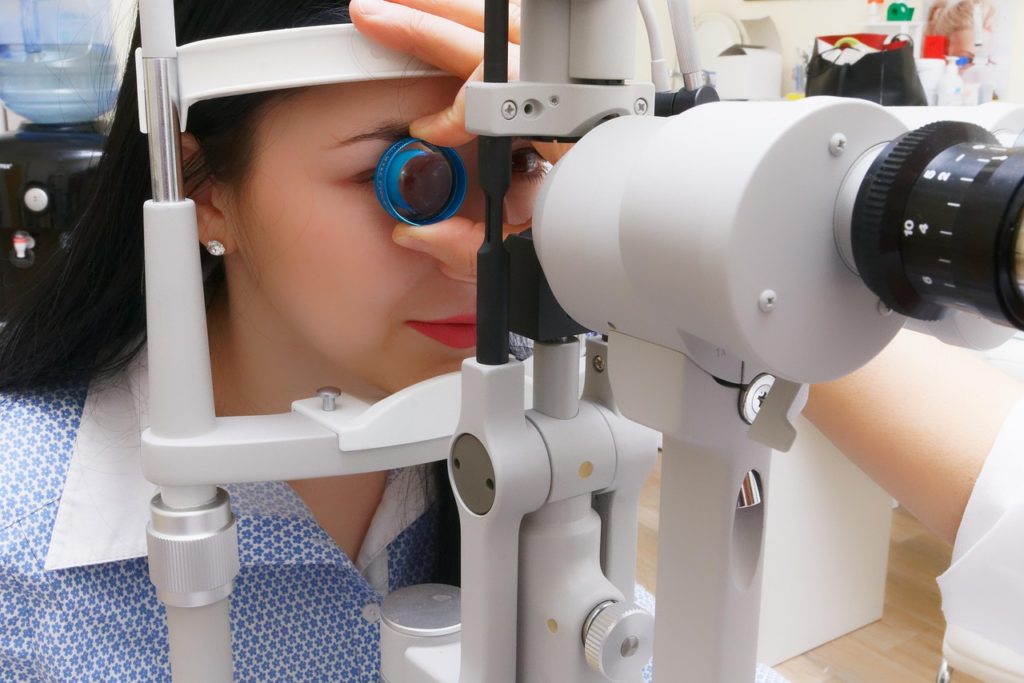
Today, AI tools are already analyzing images of the fundus of the eye or face to detect conditions such as amblyopia or refractive errors in children very early.
A deep learning model even achieved an accuracy of 79.6% for detecting amblyopia via photo-portrait…
Highly effective algorithms have been developed to predict progressive myopia . AI is paving the way for proactive, data-driven optometry, particularly for children.
Prescriptions and specialized lenses
AI also makes it possible to optimize the prescription and fitting parameters of corrective lenses or glasses.
For example, one model achieved 82% accuracy in predicting the dimensions of orthokeratological lenses.
Ultimately, this important advance could reduce trial and error and improve the personalization of prescriptions.
Practice management and customer relations
Of course, artificial intelligence is not limited to medical technology: it also plays a role in administrative management, triage, documentation, and customer experience (virtual fitting applications, trend prediction, etc.).
Opticians can thus automate certain tasks with AI and devote more time to personalized advice, a key factor in differentiation in their store.

Issues and challenges of AI for optical professionals
Validation, reliability and transparency
Although many studies show promising results, many algorithms are still in the research phase.
The transition from laboratory to clinical practice is hampered by limitations: population bias, lack of external validation, absence of standardization…
Transparency is another issue: an interpretable model (example of the SHAP model for myopia algorithms) has shown how to explain the contributing factors, which ultimately strengthens clinical confidence linked to this type of development.
Regulation and ethics
Integrating AI into eye care requires adherence to data protection regulations, liability for errors, and equitable access. An official position states that AI must "improve professional practice without jeopardizing patient safety." This opens up a whole new area of law and data for our professions, and one that is likely to evolve even more rapidly.
Training and adaptation of the profession
The possibilities are numerous, and the range of topics is constantly expanding. However, to fully harness the power of AI, opticians will need training in interpreting the tools, communicating automated results, and understanding the complementary roles of machine and expert. AI will obviously not replace professionals, but it should enable them to develop their skills and leverage their human strengths (listening, adjustment, and interpersonal skills).
Looking to the future: the opportunities of artificial intelligence in eye health
The future is already here! The next generations of AI in eye health will soon embrace a myriad of innovative practices, a non-exhaustive list of which is provided below:
- Multimodal models capable of combining OCT, fundus imaging and clinical records for deeper diagnoses.
- Decentralized screening and monitoring: AI kiosks, mobile tools, visual telemedicine…
- Further personalization: dynamic adjustment of lenses/glasses, automated wearer tracking and real-time recommendations.
For an optical professional working in a store, these trends offer an opportunity to:
- To increasingly position itself as a key player in health and prevention for its clients,
- Deploy high value-added services in your store (early detection, monitoring, prevention, ultra-personalization…).
In conclusion, Artificial Intelligence in Vision Care is no longer a distant promise: it is already well-established in screening, prescription, and vision care management. Ultimately, for optical professionals, the challenge is clear: to adopt AI as a strategic tool while preserving the core of their profession—advice, adjustments, and human interaction. By validating technologies, training teams, and building enhanced customer service, opticians can become key players in Vision 4.0 , combining innovation and expertise like never before!
Sources: