

Responsible luxury in optics: the trends for 2026
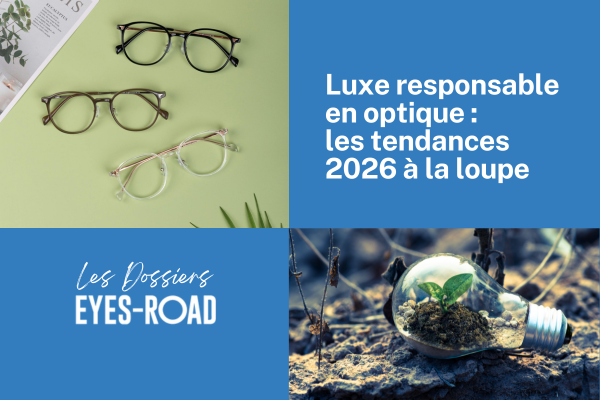 The luxury segment has established itself as one of the most structuring forces in the eyewear market. At the crossroads of design, industrial innovation, and environmental concerns , it is redefining the codes of responsible high-end . As the global luxury eyewear market continues to grow, brands and opticians are now expected to demonstrate their ability to reconcile desire, quality, sustainability, and transparency. By 2026, responsible luxury will no longer be a complementary product range; it will become a true strategic standard.
Responsible luxury, the new driver of the premium optical market
The high-end eyewear segment remains one of the most dynamic in the optical sector. According to Global Growth Insights , the global luxury eyewear market was estimated at approximately $29 billion in 2025 , with a projection of over $31 billion in 2026 , driven by Asia, Europe, and North America. But this quantitative growth is accompanied by a profound qualitative transformation. Premium consumers—particularly Generations Y and Z with high purchasing power—now expect products that embody a more responsible vision of luxury: traceability of materials, manufacturing conditions, environmental impact, and product longevity. In the eyewear industry, this shift is particularly visible. Eyeglasses, as an object of health, style, and identity, naturally lend themselves to a responsible luxury approach, where perceived value no longer rests solely on the logo or design, but on the entire product lifecycle.
Materials, innovation and circularity: the foundation of responsible luxury
The first pillar of responsible luxury in eyewear rests on materials and industrial processes . In recent years, many brands and manufacturers have invested heavily in alternatives to traditional plastics. Bio-based or recycled acetates are now becoming widespread in premium collections. According to an analysis published by MIVision , the use of responsible materials (bio-acetate, recycled acetate, bio-based polymers) can reduce the carbon footprint of a frame by up to 40 to 60% compared to conventional manufacturing.
Groups like Marchon Eyewear and Safilo are now incorporating these materials into their premium lines, without compromising on perceived quality or mechanical durability. Alongside these major players, independent luxury brands are also exploring innovative materials: recycled aluminum, lightweight titanium, bio-resins, and 3D printing processes that optimize the use of materials.

Circularity is also becoming a strong marker of responsible luxury. Frame take-back programs, material-to-material recycling, increased repairability: these approaches reinforce the idea that luxury is no longer disposable, but designed to last — a particularly powerful argument with a high-end clientele.
Responsible luxury brands: between heritage and reinvention
Responsible luxury is not opposed to heritage; quite the opposite. Historic luxury brands are investing in this area to extend their cultural and industrial legitimacy.
Kering Eyewear , for example, is progressively integrating strict environmental criteria into the development of eyewear for its brands (Cartier, Gucci, Saint Laurent). This aligns with Kering's overall strategy, which is regularly cited as a benchmark in sustainable luxury.
Some brands are taking responsible storytelling even further. Mykita , often cited for its transparent industrial approach, values the visibility of manufacturing processes, local production, and material innovation as central elements of its premium message. Responsible luxury here becomes an aesthetic language as much as an ethical one.
Among more conceptual brands, Kuboraum and Paloceras embody another facet of responsible luxury: limited editions, controlled production, European craftsmanship, and a rejection of overproduction. These models demonstrate that responsible luxury can also be radical, experimental, and culturally engaged.
Responsible luxury and customer experience: a new retail standard
Responsible luxury is not just about factories or laboratories. It is fully expressed in the customer experience , particularly in stores.
According to Euromonitor , more than 60% of premium consumers say they consider environmental and social impact when purchasing luxury products.

For opticians positioned in the high-end market, this implies a transformation of their messaging and sales process. Responsible luxury involves:
-
a pedagogy focused on materials and manufacturing,
-
repair and maintenance services,
-
a long-term approach rather than rapid renewal
-
simple and recyclable packaging,
-
increased transparency regarding the brands offered.
Premium boutiques thus become places for transmitting value, where advice plays a key role. In this context, responsible luxury allows opticians to strengthen their position as experts, encompassing aesthetics, technology, and ethics.
The challenges of responsible luxury in optics and eyewear
While responsible luxury represents a tremendous opportunity, it also poses several structural challenges. The first remains economic: sustainable materials, local production, and small production runs entail higher costs, which must be justified to the end customer.
Another major challenge is credibility. Greenwashing is now severely penalized by both consumers and regulators. In responsible luxury, proof is becoming as important as rhetoric. Labels, audits, traceability, and measured communication are essential to maintaining trust.
Finally, the market continues to face the problem of counterfeiting, which is particularly acute in the luxury segment. According to Global Growth Insights , counterfeiting continues to be a significant obstacle to the healthy growth of the high-end eyewear market.
In conclusion…
By 2026, responsible luxury will be one of the most structuring forces in the high-end eyewear industry. Far from being a constraint, it will become a lever for differentiation, desirability, and credibility. Innovative materials, circularity, authentic storytelling, and an enhanced customer experience : responsible luxury is fundamentally reshaping the sector's value chain. For brands and opticians alike, it's no longer just about selling glasses, but about embodying a vision of sustainable, conscious, and culturally engaged luxury.