

MOF Optician: a competition of excellence that reinvents itself
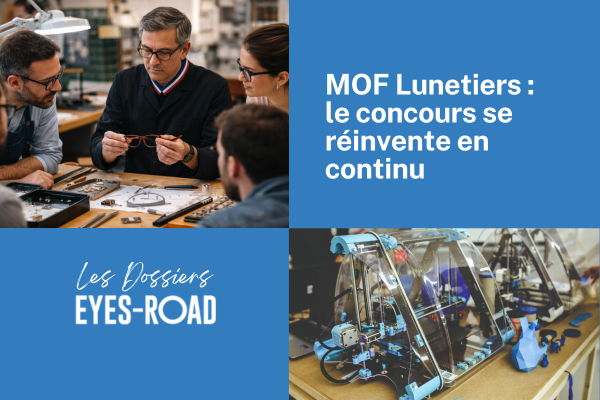
Morez, Jura. In a silent workshop, a candidate bends, adjusts, and files a frame by hand, to within a tenth of a millimeter. He has eight hours to transform a block of raw material into a perfect object. Not a second more. This is the final test in the MOF (Meilleur Ouvrier de France – Best Craftsman of France) competition – eyewear category . A competition that, since its creation, has constantly evolved to keep pace with a rapidly changing industry. 3D printing, plant-based materials, partnerships with design schools… The MOF Eyewear School has certainly changed since its beginnings!
The MOF Optician title: what it really represents
The title of Meilleur Ouvrier de France (Best Craftsman of France) is not a medal one hangs on the wall after a successful career. It is recognition from peers, obtained at the end of a demanding competition, evaluated by a jury of professionals. For the eyewear discipline, it is only awarded to candidates achieving a score above 18/20 — which means that some sessions may crown very few winners, or even none at all.
The MOF Optician competition was launched at the 2008 SILMO , the international optics trade fair. Its immediate success led to the creation of the MOF Opticians Association, founded by the first 14 winners. Its mission: to represent the discipline in France and internationally, promote the competition, and support future candidates. It was with this in mind that the MOF Opticians School was established in Morez—the French capital of eyewear—in 2011.
The 27th edition: two new laureates crowned at the Sorbonne
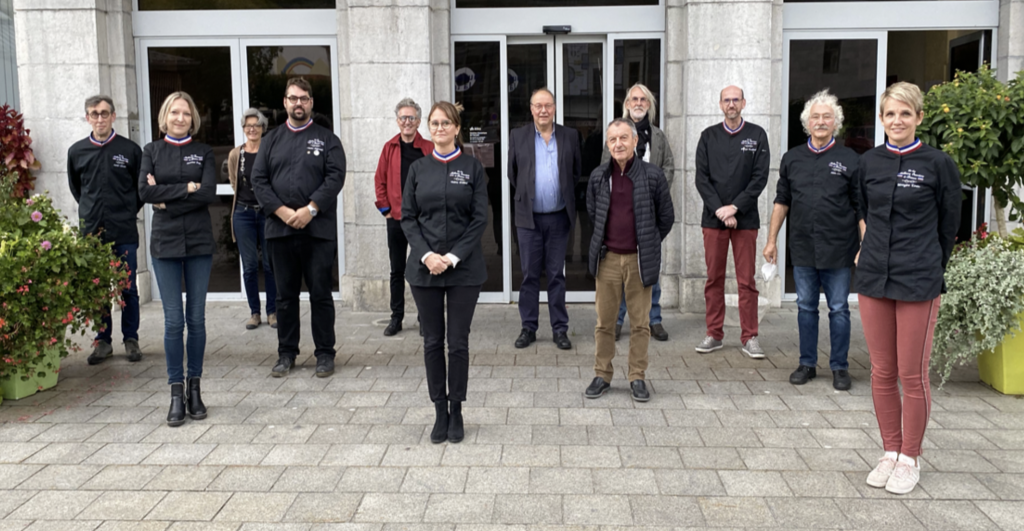
The 27th MOF Optician competition concluded in June 2023 with a ceremony at the Sorbonne. Two candidates were awarded the coveted title: Sébastien Chatelard , 35, from Guadeloupe, and Sébastien Garnier , 44, based in Monaco. They join a community of laureates that had numbered around fifty members since the competition's inception.
The path to success is anything but simple. The qualifying rounds brought together around fifty candidates at the Lycée Fresnel in Paris. Those who advanced to the final stage then traveled to Morez for the decisive challenge: creating an acetate frame and a metal clip, entirely by hand. This final stage, held in a workshop setting, now lasts eight hours —compared to three hours in the early years. This increased difficulty reflects the growing complexity of the pieces required.
The MOF Opticians' School: a structure that has grown.
From 6 to 8 trainers
Since the school's early years, the teaching staff has grown stronger. The school now boasts eight MOF (Meilleur Ouvrier de France) instructors , with the addition of two new 2023 laureates. Each instructor retains their specialty—acetate, metal, natural materials, design, or industrial production—ensuring in-depth training in every aspect of the craft. The ratio is intentionally kept low: one instructor for a maximum of three students, to maintain the quality of the support provided.
A workshop that embraces all technologies
The prototyping workshop, still based in Morez, now encompasses all disciplines of contemporary manufacturing : handcrafting, machine creation, CAD, CNC, laser cutting, and 3D printing , for frames in acetate, metal, wood, and horn. A comprehensive overview that covers both the most traditional artisanal techniques and the latest digital tools.
Training modules: two major new features
The training catalog is always structured around thematic modules, accessible to opticians, eyewear specialists, sales representatives, and staff who wish to develop their skills in one or more stages of the manufacturing process. Prices vary depending on the module, and customized training courses can be organized for groups of opticians or companies in the industry.
The introduction of two modules entirely dedicated to 3D printing has been the most significant update to the training program in recent years:
- Module 8-1 — Introduction to creating a prototype using 3D printing
- Module 8-2 — Advanced 3D Printing
These two modules complement the existing curriculum on CAD (computer-aided design) and CNC machines. With this new component, the school now covers the entire process of creating a contemporary frame—from the initial sketch on paper to the 3D-printed part, including the hand-crafting stage.
The other historical modules remain on the program:
- Module 1 — Taking measurements, drawing and shaping a frame
- Module 2 — Router-cut prototypes
- Module 3 — Shaping and assembling a metal frame
- Module 4 — Acetate/Metal Advanced Training
- Module 5 — Frames made of natural materials
- Module 7 — Creating and perfecting your workshop
- Module 9 — Frame refurbishment with industrial precision
- Module 10 — In-store modification, adaptation, and repair
- Module 11 — Manual decoration on acetate (standard, advanced and expert levels)
The CPF: good news for employed job seekers
Another notable development since our last article on the subject is the financing of exam preparation. As the MOF title is registered with the National Directory of Professional Certifications (RNCP) , employees can now use their Personal Training Account (CPF) to finance the time spent preparing for the exam. This concrete step forward removes one of the main obstacles to participation—the potential cost of training for working professionals.
MOF Opticians: the school opens up to design with ENSAAMA
This is undoubtedly one of the most exciting developments of recent years. The MOF Opticians school has forged an educational partnership with the National School of Applied Arts and Crafts ( ENSAAMA ) , one of the most prestigious applied design schools in France.
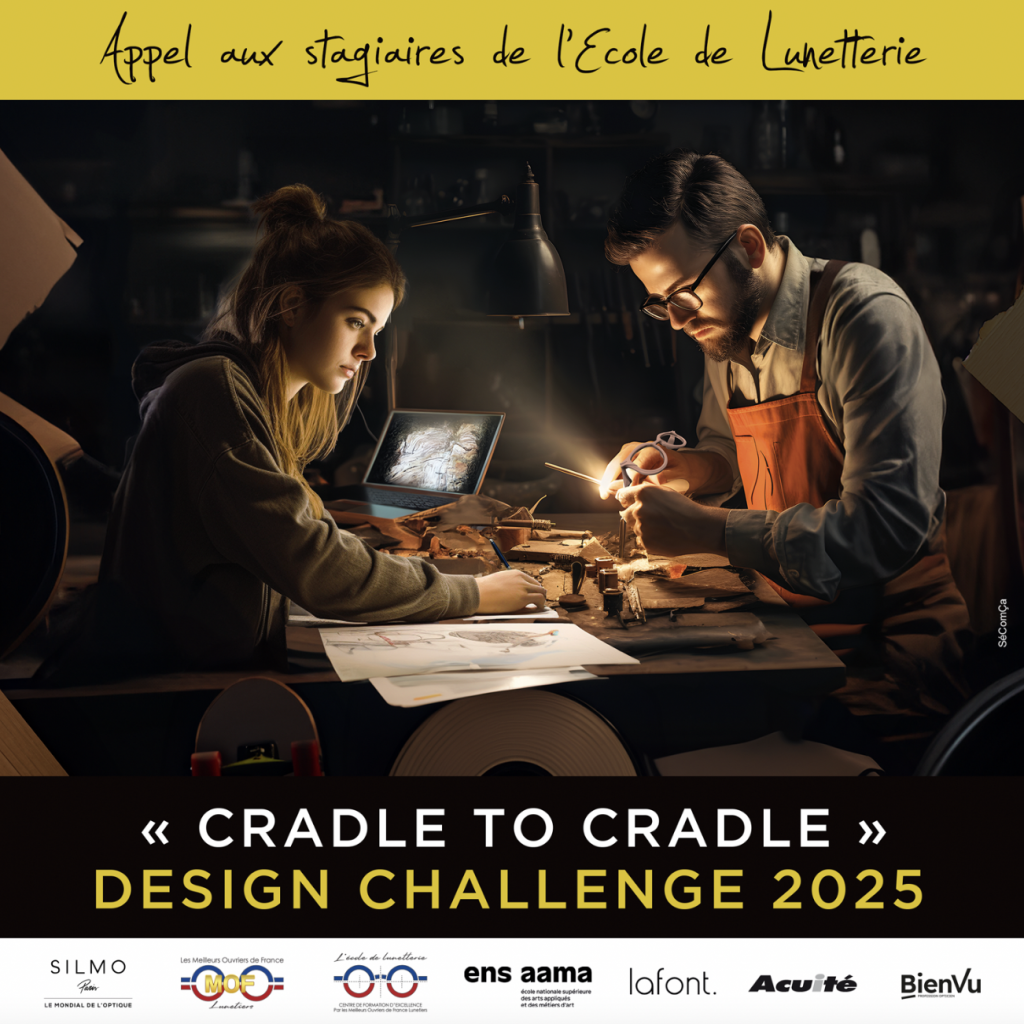
In practice, design students work alongside MOF trainees on thematic projects presented notably at SILMO. In 2024, 93 students from ENSAAMA collaborated with the school on the theme of plant-based materials , and 30 others worked on the " Cradle to Cradle " concept — designing a frame where each component can be reintegrated into a production cycle without generating waste.
This type of collaboration perfectly illustrates the evolution of the role of the school: it is no longer solely a place for the transmission of technical know-how, but a space for the intersection of excellent craftsmanship and contemporary creation.
Why aim for the MOF Optician title in the coming years?
In a sector where eyewear is increasingly seen as a fashion item and a statement of identity, the artisanal mastery of bespoke manufacturing is a rare skill—and a true differentiator. Whether you're an independent optician, a master craftsman, or the creator of your own brand, the MOF (Best Craftsman of France) Eyewear Maker title remains the strongest symbol of professional excellence in this field.
But beyond the individual reward, joining the MOF Opticians community means joining an active network, committed to promoting the profession and transmitting the essential know-how of the profession!
Featured image credit: Karolina Grabowska from Pixabay