

Myopia in Prison: A Silent Emergency?
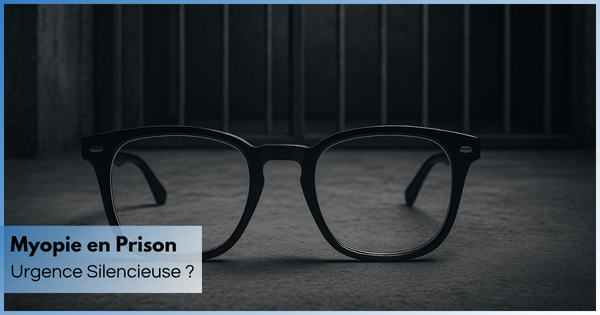
Myopia in prison is a public health issue that is too rarely discussed. Inmates often suffer from untreated visual impairments, which compromises their quality of life and safety. However, distance vision directly impacts independence in prison: finding one's way around common areas, participating in activities, and accessing education are all affected. The investigation revealed that prison medical systems have structural flaws, despite legal frameworks. It is urgent to analyze this phenomenon in order to propose sustainable solutions.
Poorly corrected eyes behind bars
In prisons, myopia often remains undetected or insufficiently corrected. A study of five urban prisons revealed that almost a third of inmates had reduced visual acuity, even <6/9, compared to only 11.4 % in the general population. Among them, a significant number suffer from uncorrected myopia, which severely limits their ability to find their way or follow daily written instructions.
Opticians in prison rarely provide routine services. Access to glasses or contact lenses requires a request, an appointment, and sometimes months of waiting. As a result, myopia in prison remains invisible, yet very present. Inmates report navigating a labyrinthine route to obtain an optical consultation. Some report having to "guess the menu or the names on the boards." The lack of clear vision reinforces their isolation, hinders educational activities, and makes them less independent in daily tasks.
This visual impairment fuels precariousness: it makes daily life more complicated, increases stress, and potentially increases the risk of conflict. Yet, the law guarantees the right to health care for all, including in prison. According to the International Prison Observatory , the state must ensure effective access to care, including eye care. But on the ground, disparities persist between institutions, and limited budgets exacerbate the difficulties.
Risks and consequences of untreated myopia in prison
Uncorrected myopia in prison isn't just a visual nuisance; it compromises the safety and overall medical care of inmates. During group activities, difficulty distinguishing people or gestures increases the risk of incidents. For professional workshops or classes, blurred vision limits learning and concentration.
Furthermore, untreated myopia can develop into severe myopia, with serious ocular complications: retinal detachments, glaucoma or cataracts . A myopic prisoner who does not benefit from regular check-ups thus increases the chances of developing these pathologies. The study conducted on prisoners also notes an over-representation of other visual disorders (astigmatism, hyperopia), but the correction of myopia, considered a priority, often falls by the wayside.
The lack of suitable optics also reinforces the feeling of exclusion. Limited access to eye care creates a gap between those who can maintain their vision correction and those left behind, exacerbating social inequalities in prisons. The consequence, sometimes overlooked, is a deterioration in the psychological well-being of prisoners.
How she is moving towards effective care ?
Pilot projects are attempting to address the vision health gap in prisons . Some facilities are hosting mobile opticians , who offer assessments and corrections directly in the prison cell or in a dedicated space. These interventions make it possible to quickly identify and correct myopia in prison, without relying on the optical fleets of prison hospital care.
Other prisons are experimenting with a partnership between the prison health service (SPIP) and mutual insurance companies or associations. The model is based on a supplementary insurance plan that covers glasses when standard coverage fails. UNADEV advocates for greater involvement of NGOs specializing in visual impairment to broaden the dynamic.
The regulations themselves can evolve: the Public Health Code guarantees medical monitoring equivalent to that of any other person, including ophthalmological care. The challenge is to turn the declaration into reality. The International Prison Observatory specifies that without clear policies, myopia in prison will never be addressed in the long term.
Myopia in prison reveals a structural deficiency in our prison health system . Deprived of clear vision, many inmates lose not only comfort, but also dignity, education, and sometimes security. Pilot initiatives are encouraging, but they remain isolated. A true public, community, and professional commitment is needed. It is time to guarantee every inmate the fundamental right to vision. Because behind every corrected gaze lies that of a person who finds their place, a little more, in a world that was thought inaccessible.