

Optics & gaming: a strategic duo for opticians
Gaming has become an intensive and continuous form of visual activity , extending far beyond the realm of leisure. Between video games, streaming, and competitions, many adults spend more than eight hours a day in front of screens, creating sometimes extreme visual strain. This article explores why optics and gaming are now inextricably linked: between visual comfort, prevention, performance, and new customer expectations, opticians must understand these trends to enhance their advice, products, and services.
Gaming reveals everyone's new visual needs
Gaming is no longer a niche activity; it's now a typical daily habit for many other groups —digital workers, content creators, students, and so on. According to recent data, nearly 60% of adults report spending more than eight hours a day in front of a screen , combining work and digital entertainment. This level of exposure can lead to eye strain, dryness, headaches, and difficulty focusing —all symptoms that opticians are increasingly observing in their clinical practice.
In this context, gaming becomes a laboratory for intensive visual usage , revealing needs that extend far beyond mere leisure. Gaming glasses , often combined with lenses that filter blue light or improve visual comfort, embody this evolution: they are designed to reduce eye strain caused by screens while optimizing contrast and detail perception during long sessions.
This trend is changing the optician from a simple prescriber to a digital health advisor , capable of offering solutions adapted to prolonged visual practices.

Product innovations with real-world applications: eyewear and technology
The market for glasses specifically designed for screen use—often marketed as “gaming” or “ blue light blocking ” glasses—is booming, driven by growing awareness of the risks associated with screen exposure. According to market research , the global market for blue light filtering glasses is expected to grow significantly , fueled by the increased adoption of digital devices and the rising demand for eye protection. The gaming glasses industry is projected to reach $79 billion by 2032 (up from $19 billion in 2024).
Gaming glasses use special lenses (often tinted) that filter out potentially harmful high-energy wavelengths , reducing glare and improving comfort. Some technologies also incorporate connected components or advanced features designed to optimize the visual experience or integration with virtual environments (AR) and immersive platforms.
For optical professionals, these innovations represent an opportunity to diversify their offerings beyond traditional optical correction, by integrating visual ergonomics solutions for prolonged screen use . This means adapting frames, offering personalized options, and educating customers on the optimal use of these products in various contexts.
Gaming and optical marketing: a remarkably effective model
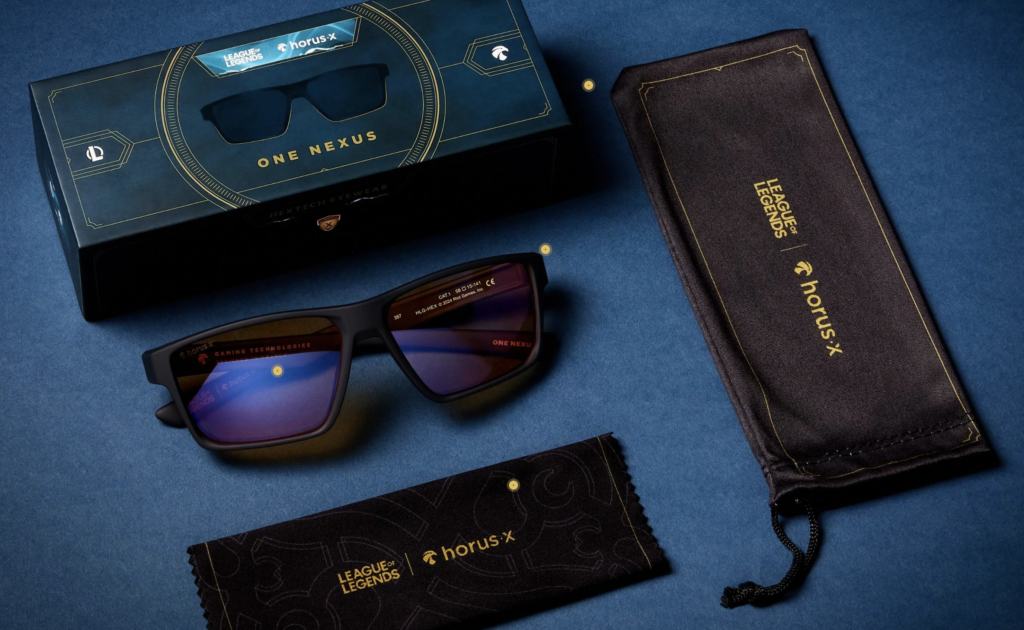
Beyond the technology, the success of gaming glasses also relies on highly structured and emotional marketing , inspired by the codes of video games and pop culture. Brands like Horus have perfectly understood this by launching officially licensed collections, such as the League of Legends – Hextech glasses , directly inspired by the game's visual universe.
These products aren't sold solely for their optical benefits, but as genuine objects of cultural belonging : strong storytelling, recognizable design, limited edition, engaged community. The gamer isn't buying "glasses," they're buying a symbol, a connection to their favorite universe.
For opticians, this approach opens up a clear business opportunity :
-
Upscaling of products with high perceived value through carefully selected licenses,
-
creation of themed or temporary window displays,
-
ability to reach a younger clientele that is often difficult to capture through traditional channels.
Gaming thus demonstrates that in optics, desire often precedes medical need , and that a well-told, well-scripted product can become a powerful driver of traffic, differentiation and margin — provided it is accompanied by credible and appropriate professional advice.
Providing advice beyond just glasses: the strategic role of the optician
The evolution between gaming and optics highlights a fundamental shift: opticians are no longer just providers of corrective lenses , but comprehensive vision health advisors . Gamers (professional or casual) share similar issues with many other intensive screen users—fatigue, irritation, sleep disruption due to blue light—and are looking for complete solutions.
This change implies several areas of work for opticians:
-
Education and prevention : explaining the effects of prolonged screen use, recommending appropriate breaks, optimizing the visual environment.
-
Enhanced product offering : offering specific treatments, personalized lenses according to usage needs rather than generic categories.
-
Integration of new technologies : integrating Virtual Reality (AR) solutions or smart glasses when they are relevant to customers.
-
Ergonomics support : postural advice, distance and lighting adjustments, support in collaboration with other healthcare professionals.
This advisory role is becoming a strong differentiating factor in a landscape where purchasing behaviors are changing and where the consumer expects professionals to provide expertise beyond simple visual correction.
In conclusion, optics and gaming should no longer be considered a mere niche topic or a passing fad. Gaming has served as a mirror to increasingly widespread visual practices , revealing needs for comfort, prevention, and performance that affect a much broader audience than just video game enthusiasts.
For opticians, this is a strategic opportunity : to enrich the offering by integrating the lessons of gaming on managing screen exposure, to adapt the advice given to new uses and to assert their role as fully-fledged visual health professionals in a world where screens are omnipresent and where vision is an asset to be preserved.